

Redevelopment with an Ownerless Flat and Applicability of Common Maintenance Charges
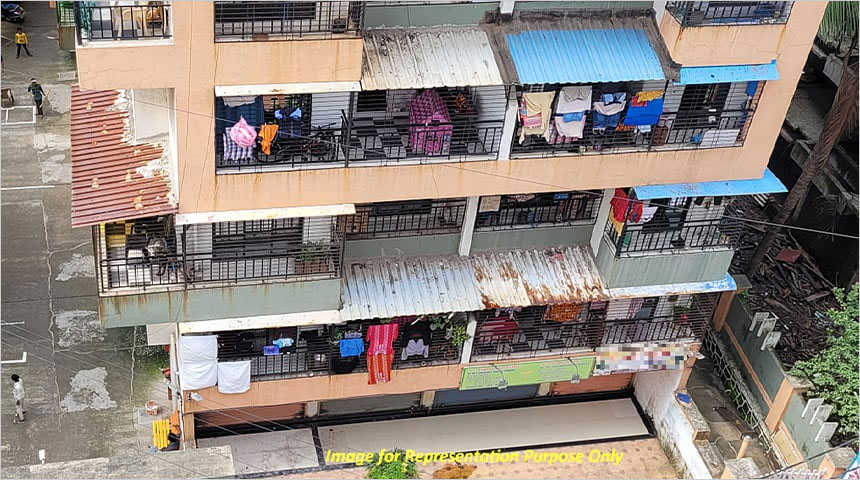
When a cooperative housing society (CHS) opts for redevelopment of their building, a consensus is required among members. A developer agreement and an agreement for permanent alternate accommodation (PAA) is signed by the owners with the approved builder. The PAA agreement provides legal standing to the flat purchaser that the newly built flat has been allotted in their name. If the developer fails to fulfil their commitment, the flat owner can initiate appropriate legal action based on these agreements.
However, in rare cases, a flat in the CHS might be ownerless due to the demise of the owner and a lack of legal claimants to the property. In such a case, the Society can still proceed with redevelopment by following a separate procedure. We are looking at one such case this week, where I have explained the process a Society has to follow to claim ownership of the said flat and then proceed with redevelopment.
 We shall also look at the rules for the applicability of common maintenance charges to commercial businesses operating in a residential society and the process of claiming for reimbursement of repair expenses from a housing society.
 Proceeding with Redevelopment if A Flat Has No Owner
Question: The owner of a flat passed away more than 15 Years ago. No legal heir or successor (wife, son who's married and married daughter) has come forward for the transfer of name on the share certificate. Society is now proceeding with redevelopment. Does the vote of such flat/premise hold ground for the consent of redevelopment?
What suggestion can the Society recommend to align the ownership in a lawful way to the legal heir/successor, wherein the Society does not incur any delay in the redevelopment process?
Answer: You can proceed with redevelopment even with the ownerless flat in your Society. On behalf of the owner, the Society will sign the agreement for permanent alternate accommodation, and the Society will take possession of that flat.
After passing the resolution in the general body meeting, the Society should give that flat on a leave licence basis when it gets possession after redevelopment. Rent so received, after paying that flat's maintenance and municipal property bill, should be kept in a fixed deposit in the name of the Society. This will allow rental income to be added to the corpus of the Society, and when someone buys that flat at a late date, the Society will get a reasonable sum for its corpus fund.
In the general body meeting, Society should also pass a resolution to make a testamentary petition in the Bombay High Court, to get the ownership of the flat to the Society after processing due procession of the law if no one comes forward to receive the ownership of the flat.
Legality of Maintenance Charges for Clinic Operating in Residential Premises
Question: I have a clinic in a residential property. The entrance to the Society and the clinic is separate. Regardless, the Society has charged my clinic with lift, parking and electricity charges even when I have a separate letter issued for commercial purposes. Please advise whether these charges are legal?
Answer: Even if your flat or clinic is on the ground floor and a lift exists in your wing, you have to pay the lift charges, per the Society's rules. All flats will be charged the same amount of lift charges, irrespective of the area of the flat.
Similarly, suppose you have a vehicle, two-wheeler or four-wheeler, and you park it inside the Society's charges. In that case, you have to pay parking charges, even if you park your vehicle only during the clinic timings.
Common electricity charges, for example, lobby, staircase, around the building, and lift, you will also have to pay. These charges are equal, irrespective of the area or purpose of the flat or shop. If you wish, you may ask for a break up of your Society's monthly maintenance charges under bye-law nos. 68 and 159.
NOTE
We will not be answering queries posted in the comments. Only questions sent through the Moneylife Foundation's Legal Helpline will be answered. If you want to seek guidance or ask questions to Mr Shanbhag, kindly send it through Moneylife Foundation's Free Legal Helpline. Here is the link: https://www.moneylife.in/lrc.html#ask-question Reimbursement of Repair Expense Incurred on Behalf of Society
Question: Recently, one of the bulbs and its holder had gone faulty in our Society's common passage on the ground floor. I requested the chairman to get it repaired at the earliest, and he told me to do it myself and claim reimbursement from Society later on. I got the work done, and it cost Rs200.
I informed the chairman and secretary about the same and asked for reimbursement, as suggested earlier. But they are no longer responding to me. I understand that this is a very small matter, but I want to know what is the procedure to follow in case the Society does not reimburse any expenditure in general that has been incurred on its behalf, with or without prior intimation to the managing committee.
Answer: With a photocopy of the repair bill, write a complaint to the secretary asking for reimbursement. In this complaint, mention that you had only carried out the repairs as an emergency with prior permission from the chairman. Ask the Society to reimburse your bill within 15 days of your letter to them and take an acknowledgement of having received the complaint from them as well.
If the secretary does not reimburse you even after 15 days, then with a copy of the above letter, write a reminder letter to the secretary, in which you will say that if you do not receive your money in the next 15 days, you will make complaint against them to the deputy registrar of cooperative societies (DRCS) for redressal.
Disclaimer: The guidance provided in these columns and on our Legal Helpline is on the sole basis of the facts provided by the reader/questioner and does not amount to formal legal advice in any form whatsoever.
(Shirish Shanbhag has an MSc in Organic Chemistry, Diploma in Higher Education, and a Diploma in French and has completed his LL.B. in first class in 2021. Before his retirement, he was a junior college teacher at Patkar College from July 1980 to May 2012, teaching theoretical and practical chemistry. Post-retirement in 2012, he started providing guidance and counselling to people on several issues, specifically focusing on cooperative housing society-related matters. He has over 30 years of hands-on experience in all matters about housing societies and can provide out-of-box solutions for any practical issue.)