
Event- Does AI Scare You? Learn To Make It Your Productivity Superpower
Event Report- Use AI with Judgement, Not Blind Trust, Says Yazdi Tantra at Moneylife Foundation’s Workshop
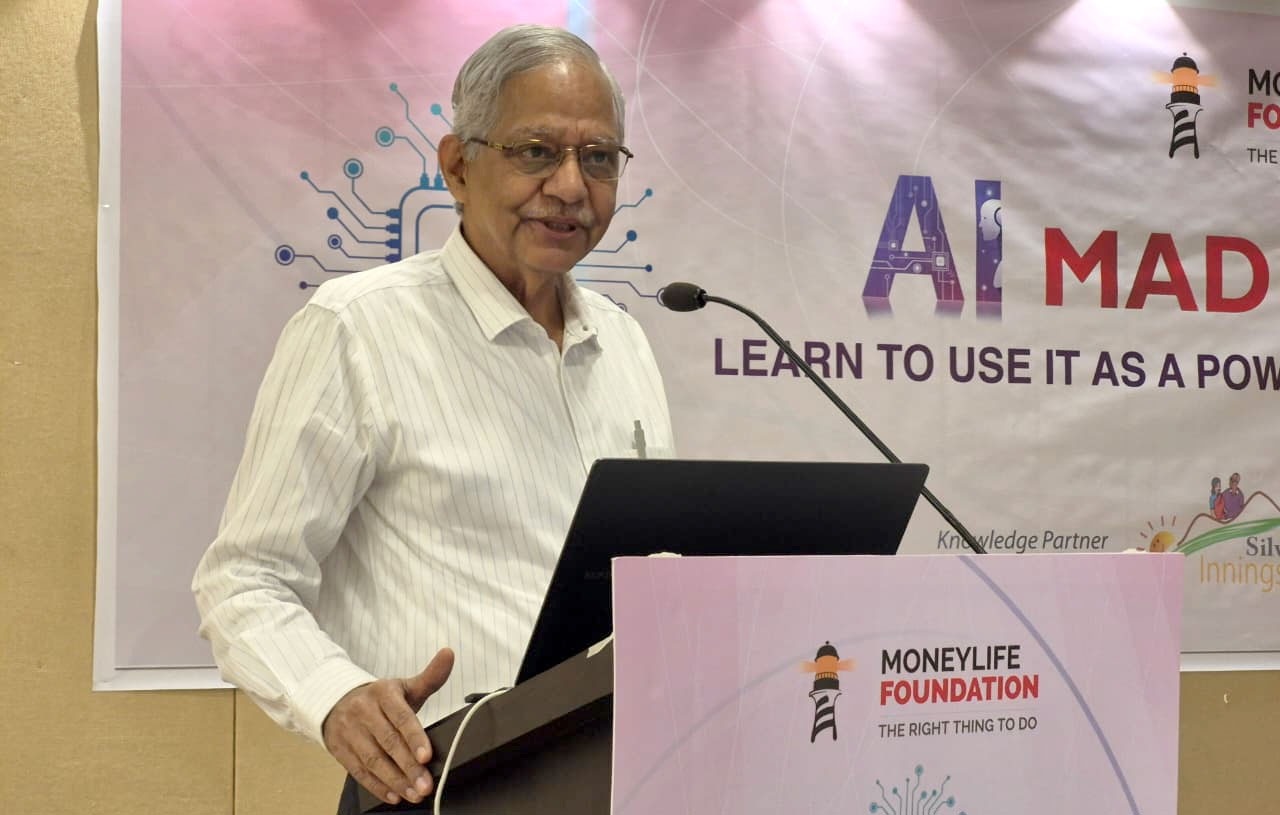
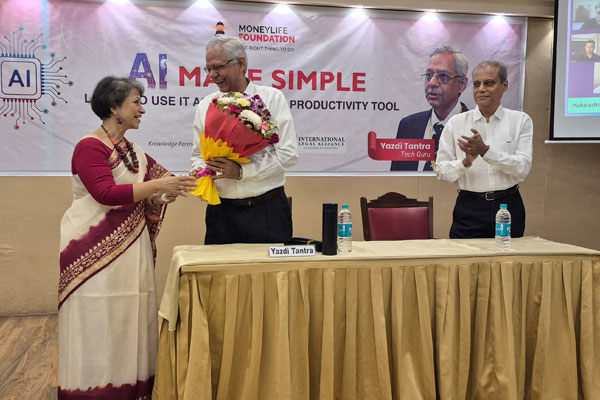
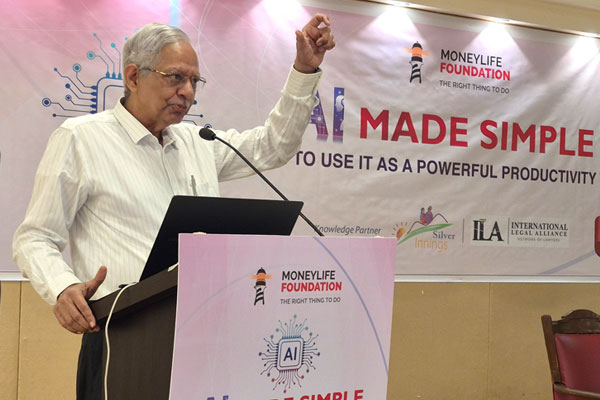
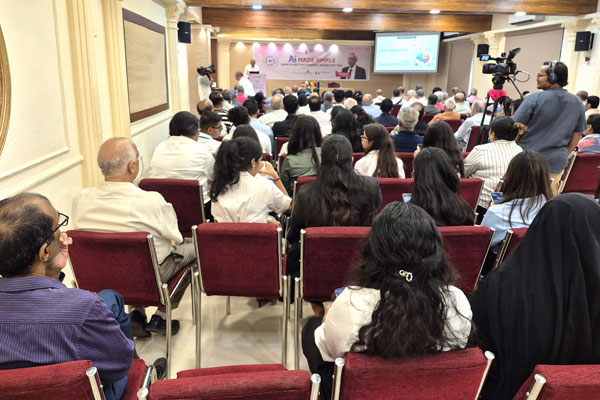
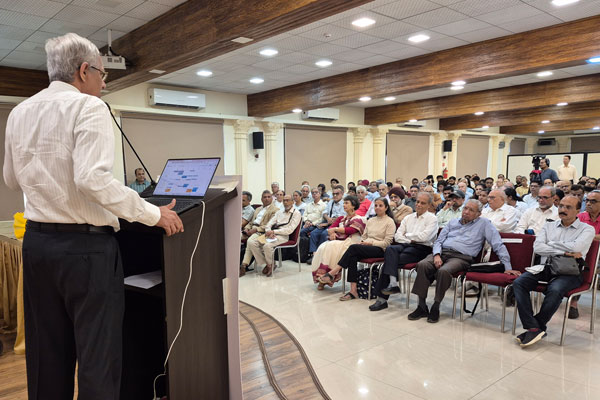
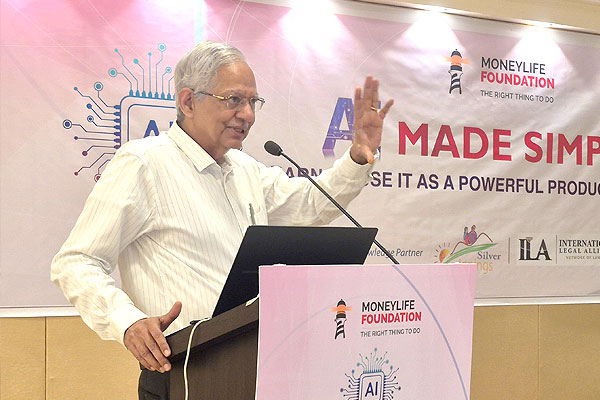
At a time when artificial intelligence (AI) is rapidly becoming embedded in everyday life, yet continues to intimidate many users, technology educator Yazdi Tantra urged people to approach AI with clarity, caution and common sense. “AI should be used as a tool, not treated as a final authority,” he said at a practical, demo-based workshop organised by Moneylife Foundation at the Indian Merchants’ Chamber (IMC), Churchgate, on Friday.
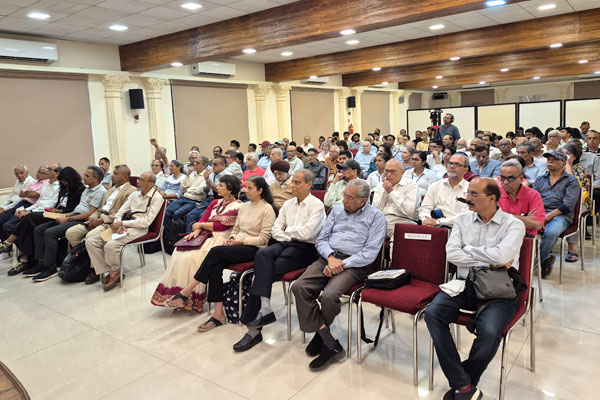
Titled ‘AI Made Simple: Learn to Use It as a Powerful Productivity Tool’, the session aimed to demystify AI and show how ordinary users—particularly senior citizens, journalists, students and working professionals—can use widely- available AI tools to improve productivity without needing technical expertise.
Mr Tantra noted that while AI increasingly influences how people write, communicate, find information and organise their work, many users remain unsure where to begin or fear making mistakes. Much of this anxiety, he says, stems from misinformation and the absence of practical, real-world guidance.
To illustrate this, he pointed out that many people already use AI daily without realising it. Features such as auto-complete and predictive text on mobile phones, grammar suggestions in word processors, autofill functions, spreadsheet projections and automated summaries are all AI-driven tools that users interact with routinely.
Building on this, Mr Tantra cited familiar workplace examples such as AI-powered features in video-conferencing platforms like Zoom. He explained how AI-generated meeting summaries help participants who join late quickly catch up on key discussion points without disrupting the meeting flow.
He then turned to email platforms, highlighting the increasing integration of AI in Gmail. Features such as AI-generated mail summaries, advanced Gemini search, suggested and auto-generated replies and tools to polish draft responses, he says, can significantly reduce routine effort.
He added that AI can also link emails with apps such as Google Keep and Tasks, making it easier to manage follow-ups, search past correspondence and interact with the inbox conversationally using Gemini.
Expanding on this, Mr Tantra said AI is now embedded across a wide range of everyday apps and platforms, including social media and messaging services. He pointed to AI-driven features on platforms such as Facebook, WhatsApp and X (formerly Twitter), including tools that assist with content suggestions, replies and search. Referring to Grok, the AI chatbot integrated into X, he showed how users can interact conversationally to seek context or information around trending topics.
He also drew attention to the growing use of AI on news websites, citing automatically generated ‘quick read’ summaries on news portals as an example. While these summaries help readers grasp key points quickly, he cautioned that users should be aware of their limitations and continue to read full articles to understand nuance and context.
Referring to widely-used stand-alone AI tools, Mr Tantra says ChatGPT remains the most well-known example, while Microsoft Copilot was among the early pioneers of AI integration within productivity software. He also highlighted Gemini, now built into the Chrome browser which offers an AI-driven search mode personalised to individual users. These tools, he explained, allow users to ask questions either by typing or by speaking, making AI interaction more natural and accessible.
On mobile devices, he explained, visual AI features further reduce barriers to use. By tapping the camera icon—often represented by a pair of spectacles—users can point their phone at an object, document, or scene and ask AI questions about it. Similar voice and visual interactions, he said, are now available across platforms such as ChatGPT, Copilot and Gemini.
Addressing what is often described as ‘prompt engineering’, Mr Tantra says the concept is far more straightforward than it appears. Using AI effectively, he explained, it depends less on technical skill and more on asking clear, detailed questions.
“There are courses being offered on prompt engineering, which I find quite funny,” he says. “All you really need to do is ask the right question.”
Drawing an analogy, he compared interacting with AI to visiting a doctor. Just as a patient must describe symptoms clearly to receive an accurate diagnosis, users must provide context and specificity to get meaningful responses from AI tools. Vague prompts, he cautioned, tend to produce generic answers.
Summarising AI’s broad applications, Mr Tantra says its major uses fall into four areas—research, analysis, generation and interaction. AI can help users research topics quickly, analyse information including basic fact-checking, generate drafts and summaries and interact through conversational tools, quizzes and question–answer formats. Used thoughtfully, he said, these functions can significantly improve efficiency while still requiring human judgement.
Clarifying common misconceptions, Mr Tantra stressed that AI tools such as ChatGPT do not independently invent facts. “AI doesn’t create facts on its own,” he says. “It picks up information from what is already available on the web and presents it to you.”
He added that many AI tools point users to sources or links, reinforcing the need for verification. “AI should be used as a starting point, not the final authority,” he says.
He also warned participants about the risk of ‘AI hallucinations’, cautioning against uncritical reliance on AI-generated output. “You have to use your own brain at some point,” he says, urging users to apply common sense and check facts rather than treating AI responses as unquestionable truth.
Mr Tantra went on to outline several practical examples of AI use across formats. Generative AI, he says, can be used to create text ranging from taglines and poems to letters, long-form articles and even entire e-books. The real limitation, he added, lies not in the technology but in the user’s imagination and intent.
He briefly explained audio-to-text applications, noting how spoken words can be converted into written text using tools such as Zoom’s transcription feature and platforms like Otter.ai, Fireflies.ai, Grain.com and Audiopen.ai. He also touched on text-to-audio tools that convert written content into podcasts, including conversational formats that many users find easier to consume.
Mr Tantra also spoke about AI’s growing role in visual and multimedia creation. AI tools, he says, can be used to create presentations and generate supporting audio, images and videos, as well as creative illustrations, cultural and fashion imagery, architectural concepts and event brochures—without requiring formal artistic training.
Another emerging use, he noted, is deploying AI as ‘experts in action’. With the right prompts, AI can be guided to function like a legal assistant, medical aide, financial planner, travel agent, interior designer or programmer, offering structured thinking and options while still requiring human oversight.
He made a special mention of finance.perplexity.com for finance-related queries, noting that it draws on information already published online and can help users quickly collate and understand publicly available data. He reiterated that such tools should not be treated as personalised financial advice.
Turning to legal applications, Mr Tantra referred to platforms such as Lex Machina, INDIAai, and Indian judicial initiatives like SUPACE and SUVAS which use AI for legal research, analytics, decision support and translation of judicial documents. These tools, he said, demonstrate how AI can enhance efficiency while leaving interpretation firmly in human hands.
Citing AIfiesta.ai as another example, Mr Tantra explained how some platforms now aggregate responses from multiple AI models in one place. Features such as ‘multi-chat’ allow users to compare outputs side by side, while options like ‘Super Fiesta’ present a single refined response after evaluating multiple answers, reducing the need to consult several tools separately.
Bringing the session to a close, Mr Tantra returned to his central message: AI is a powerful productivity aid, but only when used with judgement. The real skill, he emphasised, lies not in mastering tools, but in knowing when to question them, verify their output, and apply human reasoning—because technology works best when it supports, rather than replaces, human thinking.
A Video Recording of the Session is Available on YouTube:
Image Gallery