

Event- One Missed EMI, One Ruined Score: What You Need to Know
Event Report- When One Digital Loan Leads to Another: Moneylife Foundation Discussion Examines Loan Stacking and Debt Traps
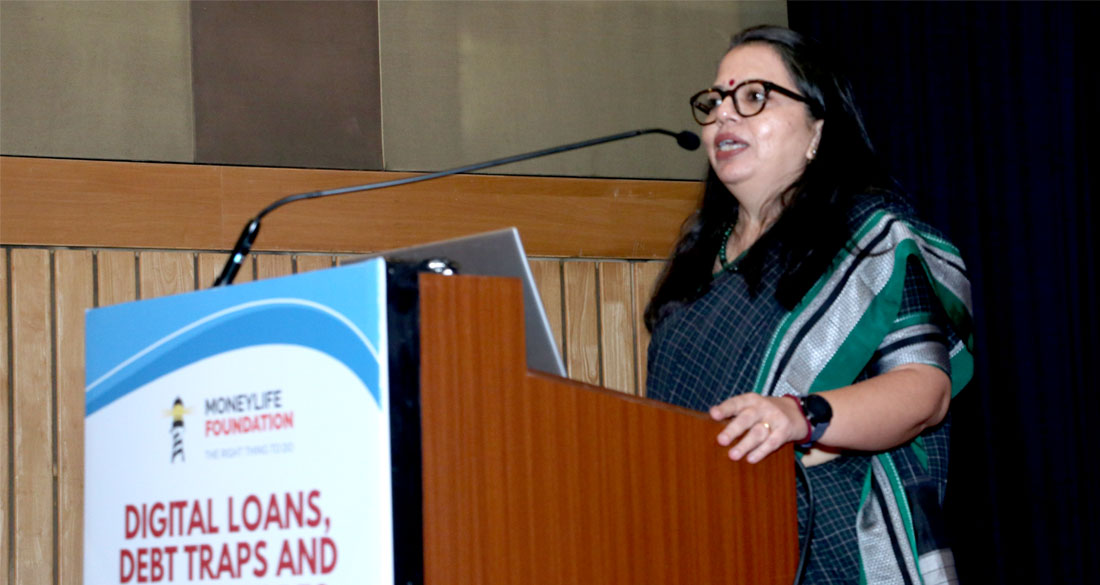
“One loan can become six. Six can become 22. And for some borrowers, the next loan is taken simply to repay the previous one,” said Aparna Ramachandra, founder-director of Rectify Credit. She was describing a pattern of multiple borrowing that has emerged from Moneylife Foundation’s credit counselling work with borrowers facing debt distress. In some cases, borrowers have accumulated several app-based loans, with fresh borrowing being used to service existing debt. What may begin as a small, short-term loan can therefore develop into a cycle of borrowing that becomes increasingly difficult to manage.
This was one of the key concerns discussed at a programme on digital lending, loan stacking, debt traps and credit scores organised by Moneylife Foundation in Mumbai on 1 October 2026. The programme brought together Ms Ramachandra, Tyuish Agarwal, a student at NALSAR University of Law and author of the Foundation's study Digital Credit Without Limits: Why India Needs to Regulate the Cost and Count of Digital Loans; and Moneylife Foundation’s founder-trustee, Sucheta Dalal.
The programme drew a significant number of students, whose questions took the discussion beyond the mechanics of digital lending to practical concerns around credit scores and how young people should approach their finances when they begin earning. The wider audience also raised questions about financial fraud, app-based loans, and how to prevent borrowers from taking on multiple loans.
Opening the programme, Ms Ramachandra highlighted how dramatically the borrowing process has changed. A traditional personal loan involved documentation, scrutiny and a conscious commitment to repayment. Today, a borrower can download an app, provide information, complete verification and receive money with very little friction. But easy access to credit does not necessarily mean that the borrowing is affordable or sustainable.
Ms Ramachandra brought the perspective of someone who has worked directly with borrowers facing debt distress. Moneylife Foundation’s credit counselling initiative, conducted in collaboration with her, has given the Foundation first-hand exposure to borrowers who have accumulated multiple digital loans and struggled to keep up with repayments.
The anonymised cases documented in the Foundation’s research revealed recurring patterns of high borrowing costs, serial refinancing through multiple lending apps, opaque pricing and recovery-related problems. In many cases, the problem was not simply the first loan, but what happened after it.
The scale of digital lending was also highlighted. Non-bank lenders operating through apps originated 13.2 crore loans in FY25-26, accounting for 77% of personal loans by number. The average digital-NBFC loan was ₹16,238, compared with ₹98,056 for other NBFCs and ₹491,000 for banks. The Foundation’s research also documented cases involving several simultaneous app loans and effective annualised borrowing costs of 365% or more after fees and other charges were taken into account.
The presence of so many students gave the discussion a particularly practical dimension. Several wanted to understand how credit scores work and what they should do when they begin earning in the next two or three years.
Ms Ramachandra advised young earners not to rush to spend their first salary simply because it had arrived, and to develop the discipline of spending money they actually have rather than immediately turning to credit cards, loans or ‘buy now, pay later’ (BNPL) facilities.
She also offered a simple technique for resisting impulse purchases. If something online feels so irresistible that you desperately want to buy it, she suggested adding it to the shopping cart—but not checking out. Sleep on it and look at the cart again the next day. If the item no longer seems worth the money, delete it. If you have spent the night thinking about it and still genuinely want it, it may be worth considering—provided you can afford it.
The larger message was that financial discipline begins well before someone gets into serious debt. Understanding one’s income, expenses, savings and borrowing capacity can be more important than simply knowing how much credit a bank or app is willing to offer.
Mr Agarwal then presented the findings of Moneylife Foundation’s study, Digital Credit Without Limits. The report draws on the Foundation’s credit counselling cases, an examination of 110 digital lending applications, the regulatory framework governing digital lending and international regulatory practices.
One of its central concerns is loan stacking—the accumulation of several loans by the same borrower. The report argues that while India's regulatory framework contains extensive requirements around how digital loans are disclosed, disbursed and collected, it does not adequately address two questions that can determine whether a borrower can actually repay: the cost of the loan and the number of loans a borrower can hold simultaneously.
The report recommends limits on the number of active digital loans a borrower can hold, alongside regulation of the cost of digital credit. It also calls for stronger reporting of loans to credit bureaus and other measures to give lenders a clearer picture of a borrower's overall exposure. Moneylife has covered the report and its recommendations separately (Read: Moneylife Foundation Study Urges RBI To Cap Borrowing Costs and Limit Multiple Digital Loans).
The discussion that followed brought these issues into more immediate focus. Interestingly, a senior citizen in the audience asked what exactly was meant by an ‘app loan’, highlighting that while digital lending has expanded rapidly, awareness of how this segment operates cannot be taken for granted. Other participants wanted to know what could be done to prevent borrowers from accumulating several such loans.
The conversation also moved into online fraud when a student shared her own experience of falling victim to a fake internship offer. What appeared to be a lucrative opportunity required her to fill in a form and pay a fee, after which the person who had contacted her disappeared. She asked how consumers can protect themselves in a world where people routinely click ‘I agree’ without reading lengthy terms and conditions.
Ms Ramachandra responded with a light-hearted analogy: a person cannot drive a car, crash it and then claim they did not know they were supposed to stop at a red light because they had never read the driver’s manual. Her point was that consumers have a responsibility to understand what they are agreeing to, particularly when money is involved.
The discussion also touched on how technology can help consumers navigate complicated legal language. Artificial intelligence (AI) tools, Ms Dalal pointed out, can be used to summarise lengthy terms and conditions and explain them in simpler language, helping people understand what they are agreeing to before proceeding.
She stressed the importance of staying alert to emerging frauds and pointed participants towards reliable awareness material, including Moneylife’s weekly ‘Fraud Alerts’ coverage.
The discussion then returned to the larger regulatory question: what can actually be done about app-based lending? Participants asked whether RBI could regulate not just how loans are disclosed, but also the amount that can be borrowed and the number of app loans a person can hold simultaneously.
Ms Dalal noted that the Foundation had already shared its research with regulatory authorities. RBI had acknowledged the report and sought further information about the lenders examined by the Foundation. She also pointed out that regulatory change can take time. The Foundation has documented the problem and submitted its findings; whether this leads to concrete regulatory action remains to be seen.
Sanjeev Chandorkar, formerly an associate professor at Tata Institute of Social Sciences (TISS), suggested that organisations working on these issues, including Moneylife Foundation and the Centre for Financial Accountability (CFA), could explore whether legal action, such as a public interest litigation (PIL), was possible.
Amitanshu Varma, a representative of the CFA, was also present. The suggestion was raised for consideration and was not a decision to initiate such action.
The October 1 discussion showed that digital lending is no longer simply a specialist financial-sector issue. For students preparing to enter the workforce, it raises questions about how they will handle their first salaries and approach credit. For existing borrowers, it raises questions about affordability and multiple borrowing. For regulators and consumer organisations, it raises the larger question of whether disclosure alone is sufficient protection when the cost of credit and the accumulation of multiple loans can themselves create unsustainable debt.
Moneylife Foundation’s study calls for digital credit to remain a tool for financial inclusion rather than becoming a pathway to chronic indebtedness. The discussion in Mumbai showed that there is considerable interest in taking that conversation further—from understanding how the digital lending ecosystem works to asking what more can be done to protect borrowers.
Avail Credit Counselling from Moneylife Foundation: https://www.mlfoundation.in/helplines/credit-counselling
A Video Recording of the Session is Available on Moneylife Foundation’s YouTube Channel: