

Fraud Alert: Can Aluminium Foil Really Stop Car Thieves? Here Is the Truth behind the Viral Post
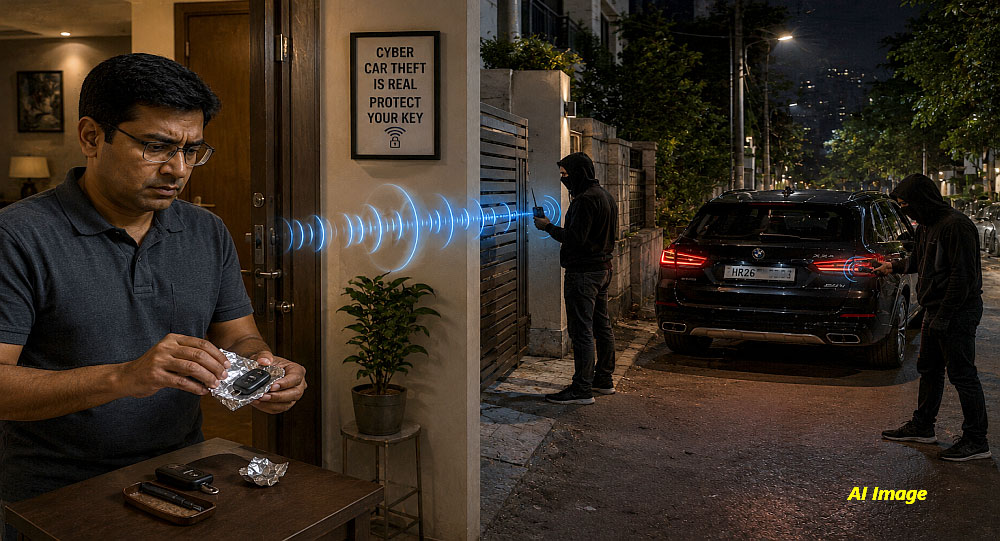
A post on X recently caught the attention of thousands of Indian car-owners. It described a man who had wrapped the key to his ₹12 lakh car in aluminium foil — not because the key was damaged or because of some quirky local superstition, but because he was worried about a very specific, very modern type of theft. The post explained that keyless cars are being stolen without a single window being smashed or a single lock being forced. No drama. No noise. Just a car that is there one moment and gone the next.
Predictably, the reactions split almost immediately. Some readers called it fear-mongering — the kind of viral nonsense that spreads because it sounds alarming enough to share. Others took it seriously, rushing to check whether their own key fobs (free on board, a small electronic device used to unlock doors or cars) were sitting dangerously close to the front door. A few commenters already started ordering signal-blocking pouches online before finishing the thread!
The truth, as it usually does, lands somewhere between the alarm and the dismissal. The post is not a hoax. But it is not the whole story either.
The Threat Is Real — and It Has a Name
A relay attack is fast and silent. The thief does not need to break in or hack the car's software. A pair of signal-boosting devices is more than enough. In the car's ‘perspective’, it appears as if the legitimate key is standing right next to it — even when the key is actually inside your home.
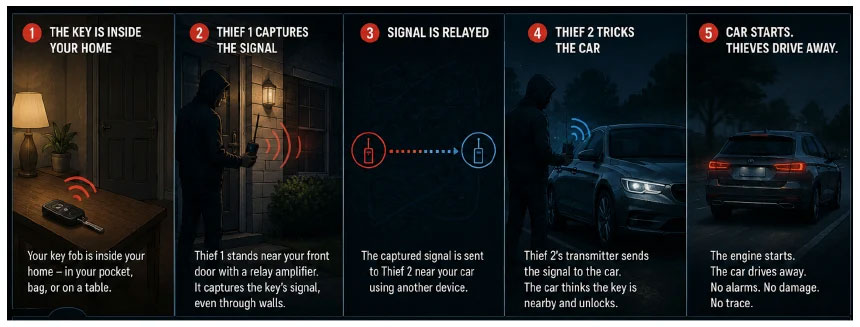
Here is how it works in practice. Two thieves operate as a team. One stands close to your front door — or even the wall nearest to where you typically leave your keys — holding a relay amplifier. This device is designed to detect and amplify the weak radio signal from your key fob, even if it is in your pocket, handbag, or on a hallway table. The amplifier captures the key's unique signal — the one that tells your car "I am here, it is safe to unlock" — and relays it to the second device.
The second accomplice is standing beside your parked car with a transmitter. The car receives the signal, concludes that the authorised key is nearby and quietly unlocks. The engine starts. The car drives away. The entire operation, from signal capture to driving off, takes under 30 seconds, leaves no signs of forced entry, and the car-owner remains clueless about how their car disappeared.
This is not science fiction. It is not even particularly new. Automotive security researchers have been documenting relay attacks for years. Tesla Model 3 and Model Y have been shown to be susceptible to Bluetooth low energy relay attacks, allowing thieves to unlock and drive away in seconds if advanced security features such as PIN-to-drive are not enabled. Hyundai, Kia, Ford, Toyota — the vulnerability is not brand-specific. There is no specific list of car models that are at risk, but rather a pattern of features: keyless entry combined with push-to-start systems that allow you to unlock and start the engine without inserting a key. If your car has that feature and you have not taken additional precautions, it is at least theoretically at risk.
Several media reports have also documented the growing use of relay attacks by organised vehicle theft gangs. A report by PCWorld explained how aluminium foil can partially block RFID signals by acting as a makeshift Faraday cage. Similar observations were reported by The Economic Times and automotive security websites discussing keyless theft vulnerabilities.
Data from the Association of British Insurers for 2024 shows that sophisticated relay attacks now account for 70% of all stolen vehicles in the UK, with insurers paying out over 1.2bn (billion) pound annually for vehicle theft claims alone.
India does not yet have equivalent published data on relay-specific thefts; but, given the rapid adoption of keyless entry systems in mid-range and premium vehicles sold here, from Hyundai Creta and Tata Nexon to the higher-end Kia, MG and Toyota sports utility vehicles (SUVs), the exposure is significant and growing.
So Why Is the Viral Post Misleading?
Because it takes a real problem and offers a single, simple, cheap fix — and implies that the fix is enough.
Aluminium foil does work on a basic principle. It acts as a crude Faraday cage — a structure that blocks electromagnetic signals from passing through. When you wrap your key fob tightly in multiple layers of foil, it can reduce or eliminate the signal that the key broadcasts. In theory, a relay amplifier standing outside your door finds nothing to capture.
Read it again. The operative words here are ‘tightly’ and ‘multiple layers’. A single loose sheet of kitchen foil, casually crinkled around a key, is not a reliable signal blocker. Gaps in the wrapping, thin coverage, or foil that has been handled repeatedly and developed small holes will allow signals to leak through.
The viral post's confident claim that '₹10 foil can save a car worth lakhs multiple times' glosses over this entirely.
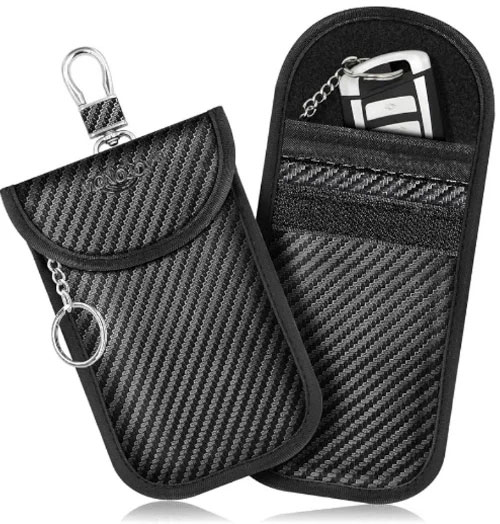 Your absolute best defence is a dedicated Faraday pouch — a small, inexpensive bag lined with a specialised metallic mesh that completely blocks all electromagnetic fields. These cost between ₹500 and ₹1,500 and are available online. They are specifically engineered for this purpose, tested to verified signal-blocking standards, and far more reliable than improvised foil wrapping. (A Faraday cage or Faraday shield is an enclosure used to block some electromagnetic fields by a mesh of conductive materials. Faraday cages are named after scientist Michael Faraday, who first constructed one in 1836.)
 The viral post also misses something more fundamental: it requires no physical access to your keys — keeping your keys unprotected near doors, or windows is enough for thieves to access the signal. Most Indian families leave car keys on a hook or shelf near the entrance of the home, precisely because it is convenient to grab them on the way out. That convenience is exactly what relay attack kits are designed to exploit. Moving your keys to an interior room, a kitchen drawer, or a bedroom — anywhere away from the outer walls — significantly reduces exposure, even without any signal-blocking solution.
What the Manufacturers Have Not Done
There is a legitimate frustration buried in this story and it is directed at the car companies themselves.
Despite years of warnings, most manufacturers have stuck with outdated cryptography and unidirectional signals. ‘Security by obscurity’ still rules, even as researchers and thieves race to outsmart each other. The result is a boom in thefts — and a booming business for aftermarket Faraday pouches that block radio signals — because your ₹40 lakh SUV apparently needs a ₹1,000 shield that the maker will not include in the box.
Some manufacturers have responded with software features. Tesla offers PIN-to-drive, which requires the driver to enter a code on the touchscreen before the car will move — even if the relay attack successfully unlocks the doors. BMW and others have introduced motion-sensing key fobs that go into a ‘sleep mode’ when stationary, automatically cutting off the signal.
Ultra-wideband technology, designed to resist relay attacks through precise distance measurement, has been introduced in newer vehicles — though even that has shown vulnerabilities in research settings.
If your car has a PIN-to-drive option or a motion-sensing key fob feature, activating it is the single most effective step you can take beyond physical signal blocking.
What You Should Actually Do
The viral post is right: this threat exists and signal blocking helps. It is wrong that aluminium foil alone is a reliable solution. Here is a layered approach that actually works:
1. Move your keys away from the front door. Keep them in a kitchen drawer, a bedroom, or any room that is not adjacent to where your car is parked. Distance matters because relay attacks take less than a minute and are completely silent — a thief will confidently steal a car under a bright streetlamp if the key signal is left unprotected.
2. Use a certified Faraday pouch. Buy one that is specifically tested and rated for key fob signal blocking, not a generic drawstring bag marketed loosely as ‘signal blocking’. Test it by placing your key inside and trying to unlock your car from a normal distance — if it unlocks, the pouch is not working. I would suggest avoiding buying it online, unless you can easily return it. Buying it from a car accessories shop in your area is preferred, as it lets you test various pouches in person before buying.
3. Enable every additional security feature your car offers. PIN-to-drive, immobiliser, steering lock, motion-sensing sleep mode on the fob — use all of them. Check your owner's manual or ask your dealership specifically about relay attack countermeasures.
4. Consider a physical deterrent as a backup. A visible steering wheel lock is not technologically sophisticated, but it adds time and effort to any theft attempt. Relay attacks take less than a minute — forcing a thief to also deal with a physical lock may be enough to make them move on to an easier target.
5. Keep your vehicle software updated. Manufacturers occasionally release security patches for keyless entry vulnerabilities. Ensure your car's firmware is up to date, particularly if you own a vehicle from the last five years with a connected systems update feature.
The bottom line: the man wrapping his key in aluminium foil understood the threat better than most car-owners do. His solution was imperfect, but his instinct was right. Any vehicle equipped with keyless entry but lacking anti-theft devices is at significantly higher risk.
In the age of connected cars, the thieves have gone digital. The response needs to go beyond a sheet of kitchen foil — but it does not need to be complicated or expensive.
Awareness, a Faraday pouch, and a few changed habits are enough to make most relay attack attempts fail.
Report cyber fraud or vehicle theft to your nearest cybercrime police station or call the National Cyber Crime Helpline: 1930
Stay Alert, Stay Safe!