

Fraud Alert: Drought, Debt and the Mule Account Trap Facing Maharashtra's Farmers
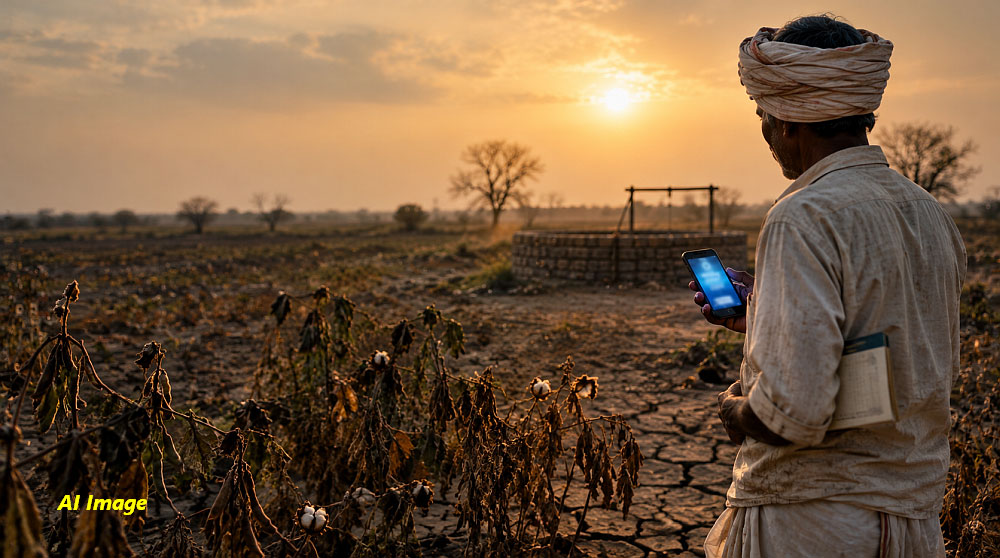
A drought does more than wither crops and dry up wells. It can also leave families so short of money that they become easy prey for criminals. That is why Maharashtra's worsening drought needs to be looked at from another angle: the risk that poor, especially the hard-pressed farmers, could be recruited as money mules by cybercrime gangs.
The trap is easy to understand. Someone struggling to make ends meet is offered what sounds like a painless deal. “Let us use your bank account to receive or send money, and you keep a commission for doing next to nothing. We are using it only for good work. We are not doing anything wrong or bad.”
Unfortunately, if money passing through that account is stolen in a cyber fraud incident, the account-holder can end up on the wrong side of a police investigation.
For a farmer already battling crop losses, debt and an uncertain next harvest, a promised commission can be hard to resist. For example, a commission of ₹500 for just allowing banking transactions of ₹10,000 (every day or every few days) is not something poor, destitute people would think twice about before accepting the deal. However, what looks like a quick way to ‘earn’ a few hundred or thousand rupees can turn into a criminal case if the money from the transaction is derived from a crime.
And remember, almost every farmer has at least one bank account.
A Drought That Should Worry Everyone
This year, the backdrop is especially grim. Between 1st June and 30 September 2026, the official monsoon period, the country received about 13% less rain than average. Maharashtra's deficit is about 19%, and some of its biggest farming regions fared far worse. Marathwada recorded a shortfall of 40%, Vidarbha 23% and Central Maharashtra 11%. Konkan is 14% short.
The district-wise rainfall figures are even more worrying. Solapur received 58% less rain than average, Beed 51% and Nandurbar 39%. Even Sindhudurg, in a region known for heavy rain, ended up 36% short. Apart from Pune, parts of the Mumbai region, Nashik and Gondia, almost every district has had below-average rainfall.
As a result, drought has been declared in at least 265 talukas, and parts of nearly every district in Maharashtra are affected. Some are comparing the situation with the devastating drought of 1972. Kharif crops have been badly hit, drinking water and fodder are scarce and rural households are under growing financial strain. Farmers are heading into the rabi season with little or no money left.
A friend told me that his uncles borrowed money and spent the entire sum, about ₹2.50 lakh, on the kharif crop. Now, he said, they have neither the money nor the heart to fight the drought.
It is not just the volume of rain. The number of rainy days has also fallen, and long dry spells have disrupted farming. Maharashtra saw rain on an average of only 40 days between June and September, and in about 93% of the state's area the rainy days were below average. The India meteorological department counts a day as rainy if at least 2.5mm of rain is recorded in 24 hours.
Too little rain, too few rainy days and long dry spells together create exactly the kind of financial vulnerability that criminals look for.
How the Mule Account Trap Works
Cybercrime gangs need bank accounts in other people's names, and the more the better. When a fraudster cheats a victim into transferring money, the stolen funds have to land somewhere. So, the gangs recruit people whose accounts can be used to receive, pass on or withdraw the cash.
These are known as mule accounts. The account-holder may be approached directly or through an agent and the pitch is deliberately simple. Provide a bank account, hand over access or transaction details, let money pass through, and collect a commission. Sometimes the agent also takes the account-holder's ATM card.
To someone with no regular income and mounting debts, even a 5% commission can look very attractive, that too without doing anything. When that happens, the account-holder is no longer just a person earning a commission. His or her account becomes part of the money trail in a crime investigation.
A recent investigation by the Telangana cyber security bureau shows how widespread this racket has become. In a two-week operation, the agency arrested 101 people, including 18 women, across Telangana, Andhra Pradesh, Karnataka, Tamil Nadu, Kerala and Puducherry. Investigators traced fraudulent transactions of about ₹17 crore and identified 1,172 cybercrime links across the country. Of those arrested, 19 were agents and 81 were mule account-holders.
According to investigators, account-holders and middlemen were allegedly paid commissions of up to 5% of the fraudulent money routed through their accounts.
People behind These Mule Accounts May Surprise You
One of the biggest lessons from the Telangana case is that mule accounts are not always run by hardened criminals. Investigators allegedly found a corporate employee, a former serviceman, a Flipkart employee, an MBA graduate, a businessman and people linked to non-government organisations (NGOs) among those connected to the network.
An employee of Tata Capital was allegedly working as an agent, arranging mule bank accounts for cybercriminals in return for commissions. A single bank account operating from the Sultan Bazar area was linked to 496 complaints across several jurisdictions. A graduate working for Flipkart allegedly allowed his account to be used for fraudulent transactions which were tied to 50 cybercrime cases across India.
An ex-serviceman was allegedly linked to six cases. The account of another accused, who holds a diploma in film technology, was linked to 26 cases, and an MCom-qualified businessman's account to 34. An MBA graduate who served as the marketing head of the Manju group of companies was linked to 15 cases, according to the bureau.
Investigators also found that NGO trust accounts were allegedly being used to receive and move cybercrime money. Those accounts were linked to 60 cases across India.
Recently, the Aurangabad bench of the Bombay High Court rejected an anticipatory bail plea of a man whose bank account received ₹4.03 crore of a ₹7.17 crore ‘digital arrest’ fraud. He claimed he had shared his bank details only to receive a promised ₹20 lakh donation for his charity and that his phone had been hacked, but the court found no evidence to support the hacking defence.
“Any frivolous or afterthought explanation by the persons whose accounts are credited with crime money would amount to lending encouragement to the commission of such crimes,” the HC said, while rejecting his application.
The message for rural Maharashtra is therefore plain. Being a farmer, an employee, a graduate, a retired soldier, a college student, or a small trader does not make anyone immune. Cybercriminals want access to bank accounts and look for people who can be persuaded (read: easily fooled) to provide it.
'I Didn't Know' May Not Be Enough
This is where the trap turns truly dangerous. A person may honestly say that he did not know the money had been stolen. He may have been told the account was needed for a genuine business deal. He may simply have been promised a commission for letting payments pass through. And all this may be the truth.
But once a fraudulent transaction is traced to the account, the holder can come under police scrutiny. Police may look at bank statements, mobile phones, SIM cards, ATM withdrawals, cheque books, digital messages and the identities of others connected to the account.
The Telangana case gives a sense of the scale. The 101 arrests were linked to 51 cases registered at seven cybercrime police stations, and 50 of those arrested had links to more than five crimes.
For a farmer already coping with drought and debt, losing access to a bank account or being dragged into a police inquiry could make a bad situation far worse.
There is a wider risk too. Once someone agrees to be a mule, the criminals may ask for more: cheque books, debit cards, OTPs or banking passwords. What begins as an offer of commission can quickly give them complete control over a person's financial identity.
Drought Relief Must Carry a Cybercrime Warning
This is why Maharashtra's drought response cannot stop at water tankers, fodder, crop relief and financial aid. A cybercrime warning must be built into the relief and awareness work reaching drought-hit villages.
Farmers receiving crop-loss compensation, government benefits, loan relief or other support should be told, in so many words, never to hand their bank accounts to agents or strangers. The warning should be direct, repeated and delivered in Marathi:
• Do not let anyone use your bank account for a commission.
• Do not hand over your ATM card, cheque book, SIM card, PIN, OTP or internet banking details.
• Do not accept money into your account and pass it on to another account because someone promises you a commission.
• If someone approaches you with such an offer, the safest response is to say NO and walk away.
The same message should reach village-level officials, cooperative societies, banks, farmers’ organisations, self-help groups and local leaders, because these are the people farmers trust and turn to in hard times.
Bank employees also have a part to play. When a dormant or little-used account suddenly starts receiving and sending large sums, that should trigger proper monitoring and a word of advice to the customer. In a recent investment scam, a bank official spotted the account-holder, a senior citizen, transferring lakhs of rupees every few days to new accounts and alerted the family.
The Real Cost of a 'Quick Commission'
Cybercriminals thrive on two things: deception and vulnerability. A person with a steady income may well turn down an offer to earn a small commission by lending his bank account. Someone who has lost his crop and cannot see how the family will cope over the next few months may see the same offer very differently and will act without even thinking.
That is why the mule bank account problem is not just a cybercrime issue. It is also a question of financial vulnerability. Maharashtra's drought has left thousands of families hunting for ready cash, and we must ensure criminals do not exploit that desperation into one more source of fraud.
The Telangana case should be read as a warning, not just another list of arrests. Cybercrime networks do not always go looking for hackers. Sometimes they look for an ordinary bank account-holder who desperately needs money for himself and his family to survive.
And the cruellest part of the offer is the order of events. The commission arrives first. The police notice comes later. By then, what looked like an easy few thousand rupees may have become a criminal case, with the account-holder left to explain why stolen money passed through his account.
For Maharashtra's drought-hit farmers, the message should be clear. Never rent out or allow anyone to use your bank account. Never let anyone route money through it for a commission. And never assume you will be safe just because you did not commit the original fraud.
The first line of defence is awareness. In today's circumstances, that warning has to reach every drought-hit village before the cybercriminals do.
Stay Alert, Stay Safe!