

Fraud Alert: How 'Free Money' Apps Can Turn Young Bank Users into Cybercrime Mules
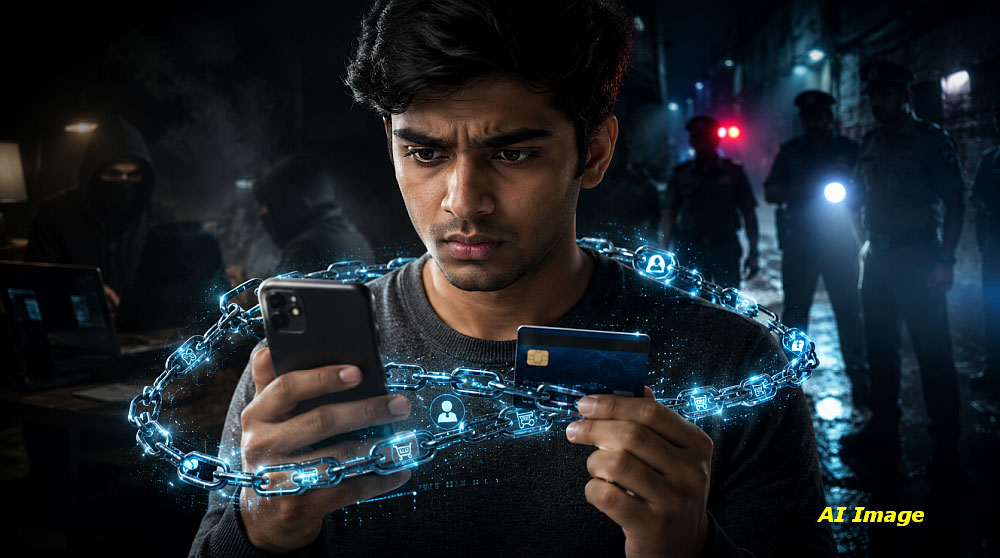
"I thought I had found an easy way to earn a little extra money."
That is more or less how these stories always start. This time it was an app called Rushpay (it claims to allow users to buy and sell ‘Rush’ tokens directly with other users) — deposit some cash, get it back within minutes, plus a little bonus on top. Simple, or so it seemed. And Rushpay is not alone. There are many, for example, Incoin Pay, Six Pay Wallet or any C2C (coin-to-coin) wallet.
One young bank customer told me that he made several of these transactions without thinking twice about it. "I was using an app called Rushpay around that time, where you can add money and get it back with a bonus within minutes. The national cybercrime portal (NCRP)-disputed amounts of ₹723.12, ₹2,000 and ₹300 match the kinds of transactions I made through that app. I didn't know then that this money could be fraud-linked or disputed — I only realised the connection now after seeing the transaction dates and amounts match."
The money credited in his account was cashback, basically. Except it was not.

His account got frozen after cyber fraud complaints traced back to those exact transactions. Six months on, he still can't touch his own money. And here is the part that is genuinely hard to believe: While the account sat completely locked — no credits, no debits, nothing — the bank still managed to quietly pull ₹5,212.84 out of it, in two separate deductions, with no explanation given. He tried to pull his statement to figure out what happened. That was blocked, too.
This is what is called a money mule situation and it is happening to a lot more young Indians than you think.
So What Actually Is a Money Mule?
Basically, someone whose bank account is used to receive, move, or withdraw money that came from fraud, often without the account-holder fully realising it at the time.
People assume this only happens to criminals or people who know exactly what they are doing. Not really.
Increasingly, it is students, fresh graduates, gig workers and anyone who has just opened their first account. Fraudsters like new accounts specifically because they don't have much history yet — less scrutiny, fewer red flags tripped.
Nobody Advertises Herself as a Fraudster
The pitch is never ‘help us launder money’.
It is:
• Complete a few simple online tasks, get paid
• Deposit money, get an instant bonus back
• Cashback in minutes, no catch
• Become a ‘payment partner’ and earn commission
• Work from home, guaranteed income
• Trade in peer-to-peer (p2P) tokens or coins

You will see this stuff on Telegram, WhatsApp, Instagram and, sometimes, as a stand-alone app. It gets dressed up as a promo campaign, a merchant settlement, digital marketing, (digital) coin trading — whatever sounds official enough. And there is always some version of ‘zero risk’ attached. Many of these schemes (read: scam) are actually money circulation (referred to as a collective investment scheme-CIS by regulators) or Ponzi/ pyramid schemes, where you ‘earn’ income from money ‘invested’ by new recruits.

Obviously, there is no such thing as free money, commission or bonus. But it doesn't feel obvious in the moment, especially for a youngster eager to make a mark by earning easy money.
Why Mostly Young People Are Getting Caught in This
A few reasons stack up here. First bank account, limited financial literacy, wanting a bit of extra income on the side — put those together and you have got someone who does not see the harm in ‘just letting money pass through’ their account for a small cut.
The thing they are missing: fraudsters need real accounts, attached to real people, to actually move stolen money before it lands somewhere the masterminds can access safely. Every account that looks clean and ordinary helps break the trail that investigators and law enforcement agencies (LEAs) are trying to follow.
Sometimes, there is not even a commission offered. Just a cashback scheme or a ‘free money’ app nobody has heard of. Accept the deposit, forward it along and — without meaning to — you are now part of a fraud network.
How An Innocent Transaction Turns into Evidence against You
Say someone gets scammed out of ₹50,000. That money almost never lands straight in the cybercriminal's own account — too easy to trace. Instead, it gets bounced through several accounts belonging to people who have no idea what is going on.
When investigators eventually trace the money (proceeds from the crime), your account is one of the stops. And at that point, the system or LEAs do not know you are innocent. They just know your account is in the money trail.
Several High Courts have held that the blanket or disproportionate freezing of bank accounts, particularly when the account-holder is neither an accused nor a suspect in the case under investigation, is manifestly arbitrary. The Supreme Court of India is actively supervising this broader issue in Vivek Varshney v. UOI (SC agrees to take up plea for SOP on freezing, de-freezing bank accounts in cybercrime cases).
However, in practice, whenever a bank or financial institution receives a letter or memo from a LEA, it first freezes the account, regardless of the disputed amount.
When an account is frozen, funds are held. Digital banking stops working. Often, the account holder finds out only when they try to withdraw their salary or make a UPI payment, and it just... doesn't go through.
The Fallout Is Worse Than People Expect
Like with the Rushpay case above, even small, disputed amounts can trigger long freezes. Suddenly you can't touch:
• Your salary
• Your savings
• Scholarship money
• UPI or debit card transactions
• Net banking, period
For weeks. Sometimes months. Household expenses get complicated fast when you can't access your own money and some people can't even pull a statement to understand what actually happened to their account. It is stressful in a way that is hard to overstate.
What Regulators Are Doing about It
There has been movement here. In May 2026, the Indian cybercrime coordination centre (I4C) — under the Union ministry of home affairs (MHA) signed a memorandum of understanding (MoU) with Reserve Bank Innovation Hub (RBIH), aimed at tightening coordination between banks and law enforcement on this exact problem.
The idea is faster sharing of fraud-risk intelligence, better analytical support and quicker identification of suspicious transactions before they snowball — basically, catching mule accounts earlier rather than after the damage is done.
RBI has rolled out MuleHunter.AI, a machine-learning system built to flag mule accounts by analysing transaction behaviour. It is already live in 26 banks and expanding. Banks have also been told to tighten real-time transaction monitoring, lean on artificial intelligence (AI) and machine learning (ML) to spot unusual patterns and use network analytics to catch organised mule networks rather than just individual accounts.
All of that should catch unusual activity faster than before. But tech only goes so far — a lot of this still comes down to people knowing what to watch for.
Red Flags Worth Taking Seriously
Be wary if someone asks you to:
• Receive money into your account for a cut
• Move that money out again right away
• Hand over your debit card, UPI PIN, or net banking login
• Let someone else operate your account
• Open an account specifically for a ‘business opportunity’
• Install some payment or investment app promising fast, guaranteed returns
• Keep depositing money to keep the ‘bonuses’ coming
• Basically, just keep the account alive to pass payments through
If it feels like free money, it is worth pausing and asking: Why would a stranger or someone you hardly know pay you just to use your bank account?
Usually, it is because they can't use their own.
What Actually Helps
• Don't let anyone else use your account, ever
• Don't accept money on behalf of people you don't know
• Be sceptical of apps promising quick, unrealistic returns — check if they are actually regulated
• ‘Guaranteed income’ and ‘risk-free earnings’ are not real things
• Keep your transaction records
• Flag anything suspicious to your bank immediately
• If your account does get frozen, get the reasons in writing and cooperate with whoever is investigating
You don't need to get hacked for your account to get misused — sometimes all it takes is believing that easy money doesn't come with strings attached. A few hundred rupees from a cashback app or a bonus scheme feels harmless enough. But if that money is dirty, your account becomes part of the chain, whether you meant it to or not.
And by the time you realise what happened, you are often already locked out — savings inaccessible, name attached to a case you didn't ask to be part of.
If you are opening your first account, it is worth remembering: it is not a side hustle. There is no version of this where a stranger pays you just to move money through your account, and it works out fine for you.
Stay Alert, Stay Safe!
How To Report Cyber Fraud?
Do report cybercrimes to the National Cyber Crime Reporting Portal http://cybercrime.gov.in or call the toll-free National Helpline number, 1930. To follow on social media: Twitter (@Cyberdost), Facebook (CyberDostI4C), Instagram (cyberdostl4C), Telegram (cyberdosti4c).
Are you a victim of Online Financial Fraud? Immediately call helpline Number 1930 and register your complaint at https://t.co/cr6WZMOi4c pic.twitter.com/HZqUMKSDNF
— Cyber Dost (@Cyberdost) October 12, 2022
NOTE: If the fraud involves your bank account, you need to immediately send an email to the official email address of your branch (available on the bank's website or on the first page of your passbook), with a copy to the bank's customer care. Even if you have called the official customer care number, you must still send an email describing your conversation with the bank executive, including the time, date, and duration of the call. This will be helpful if you face a liability issue with the bank.