

Fraud Alert: That ₹2 Trial Could Quietly Turn into a ₹599 Debit!
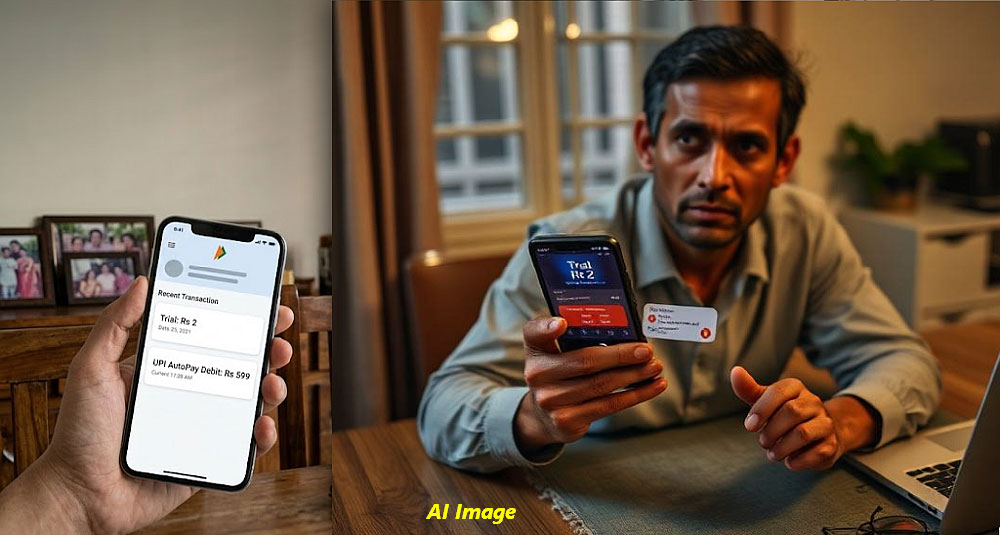
There is a particular kind of online trap that works precisely because it does not even look like a scam at all. No threatening message. No stranger posing as a bank official. No demand for a one-time passcode (OTP). Just an app, an attractive offer, a free trial or a trial fee so small it barely feels worth a second thought.
₹1. ₹2. Maybe ₹5.
You tap; you may pay a small amount and start using the service.
Then the SMS from your bank arrives.
That is usually the moment people discover that the small trial fee or free trial is never really the whole story. A unified payments interface (UPI) autopay (since it is commonly used, I am using this as an example of a payment method) mandate may already have been quietly set up in the background, giving the app or service provider permission to collect a far larger amount once the trial ends or the subscription renews.
A Reader's Experience — And it Isn't an Isolated One
A reader recently shared an experience worth passing on to anyone who signs up for apps and online services without a second thought.
The reader had installed a short-form drama app after spotting what appeared to be a low-cost trial. The trial began on 10th May, and the offer seemed cheap enough to be almost an impulse tap. Within a day or two, though, the reader noticed that a ₹599 UPI autopay debit had gone through to the app via PhonePe — nowhere near the small amount he thought he had agreed to.
Not wanting to continue with the service, the reader emailed the app's support team on 13th May, requesting cancellation of the subscription and a refund, and duly provided the user ID linked to the account.
What followed will sound wearily familiar to anyone who has ever tried to get a subscription cancelled or a disputed payment reversed.
The company asked when the app had been installed. The reader answered. Back came a reply saying the matter was under review and would take 24 hours to 48 hours. The reader waited, then followed up, and was asked for proof of payment, which he duly sent as a screenshot of the PhonePe transaction. The response this time was that the ₹599 debit was valid because it had been charged after the trial period ended.
Still, the reader pressed for cancellation and a refund. On 22nd May, he was told that the refund was being processed and could take seven to ten working days. Later, he was told to check his bank statement. The money or refund was not there. On 17th June, the reader followed up again, saying the refund still had not arrived, and received an apology from the company along with a promise that the matter would be escalated to a senior team, plus a suggestion to move the conversation to WhatsApp. Two days later, on 19th June, he was told, once more, that the refund is being processed and would take another seven to ten working days.
At the time of writing, the reader says he is still waiting for confirmation from his bank that the ₹599 has actually been returned by the app.
This, however, is not a one-off tale. The pattern behind it has been showing up in the news with increasing regularity.
Earlier this year, a Mumbai professional's post on LinkedIn went viral after he discovered several active autopay mandates on his mother's phone that she had no memory of setting up. Lokesh Ahuja, who works at Nykaa, had taught his mother to use UPI a few months earlier, and while checking her payment settings, he found multiple mandates linked to free trials that had quietly converted into paid subscriptions after the trial period ended. As he pointed out, offers that loudly advertise ‘₹0 for the first 30 days’ often bury the fact that you are simultaneously approving a recurring payment that will keep going until someone actively cancels it.
The problem has become common enough to attract regulatory attention, too. According to a report from Business Standard, the Reserve Bank of India (RBI) has reportedly asked the National Payments Corporation of India (NPCI) to look into complaints about disputed UPI autopay debits, with music apps, OTT platforms and AI tools all cited as offenders that turn a token ₹1 sign-up fee into ongoing monthly deductions.
And it is not just anecdotal. A nationwide survey covered by the same newspaper, drawing on more than 44,000 responses across 363 districts, found that 32% of online banking users said they had experienced a ‘subscription trap’ — where signing up is effortless, but there is no straightforward way to get out once recurring charges begin. Another 39% reported a ‘bait and switch’ pattern, where the deal on offer changes shape once you are already in.
In March this year, a survey by LocalCircles found that 80% of users who purchased insurance policies through online platforms had experienced manipulative 'dark patterns' such as subscription traps, forced actions and misleading pricing. “In fact, in the past 24 months, the percentage of users who bought an insurance policy via online platforms and had difficulty cancelling it or experienced a subscription trap dark pattern has increased from 61% to 80%,” LocalCircles said.
The common thread running through all of this is the same one that ran through our reader's ordeal: the trap is rarely in the sign-up. It is in what you unknowingly agree to further down the line: the autopay mandate.
Mandate is the Real Trap, Not the Price
Most of us understand a subscription in fairly simple terms — pay a small amount or nothing at all (free trial), try the service, and decide later whether to keep it. In an autopay, however, the mandate quietly changes that equation.
When you approve a mandate, you are not just paying for today. You are giving a merchant or service provider standing permission to initiate future payments, on whatever terms that mandate lays out. Which means the number that actually matters is not the one being deducted right now — it is the amount you have authorised for later deduction or payment.
That is precisely where people get caught out. A promotional screen might proudly display a minuscule amount or even a free trial, while the real renewal figure sits somewhere less obvious — smaller text, perhaps, or buried in a separate payment-authorisation screen. Someone in a hurry, or simply assuming the trial is the whole deal, taps through without quite grasping what they have signed up for.
Multiple users on Reddit report a consensus that Amazon's promotional links can sneakily opt users into auto-renewals or charge regular monthly fees immediately if the system flags the account as an ineligible returning subscriber. “Recurring payments will be enabled automatically for your membership, if you chose an eligible payment method. Recurring payments may also be initiated at the time you are changing the plan for your membership,” Amazon India says in its terms for Prime paid membership.
The payments that follow after the ‘trial’ can look entirely legitimate. Technically, it often is. Which is exactly what makes this so hard to spot as fraud in the first place. There is no stolen password here, no fake call from ‘the bank’, no OTP handed over under pressure. The consumer did, technically, approve the mandate — just without fully appreciating what that approval actually committed him or her to.
Cancelling the Subscription Isn't the Whole Job
Here is a lesson worth remembering: if you decide you no longer want a subscription, cancelling it in the app is only half the job.
You also need to check the UPI mandates or the autopay section in the payment app. If you use PhonePe or Google Pay, for instance, look for the section listing active mandates, autopay instructions, or recurring payments and check whether the service you thought you had walked away from still has one quietly active. If it does, revoke it.
Think of it this way: cancel the subscription at the merchant's end and cancel the payment permission at the UPI app's end. Do only one, and you could still be exposed to another debit down the line.
Menus and wording shift as payment apps update their interfaces, so don't rely on an old screenshot or video claiming to show exactly where a button lives. Just look for whatever your app currently calls its mandates, autopay, or recurring payments section.
The 5-second Check That Can Save Your Money
Next time an irresistible ₹1 or ₹2 or even a free trial pops up, resist the urge to tap straight through. Give it five seconds and ask yourself three questions:
1.What am I paying right now?
2.What will I be charged later?
3.Have I just authorised an autopay mandate?
That second question is the one that matters most. If the trial is ₹2 but the next payment is ₹599, ₹699 or ₹999, then ₹2 is never the offer — it is simply the entry fee. Or consider it like this: you are allowed to enter a zoo free of cost, and only later do you learn you need to pay to stay safe from the wild animals let out of their cages, or to get out of there!
Read the payment authorisation screen carefully before you approve it. Look for the recurring amount, frequency, start date, end date and any maximum amount your UPI app shows. And take a screenshot while you are at it (some ‘extra smart’ apps don’t allow screenshots, so you may need to use their website to capture them). It might feel excessive for a cheap entertainment app, but if a dispute arises later, that screenshot is your evidence of exactly what you saw, what you paid and what you were told at the time.
Don't Let a Refund Promise Be the End of the Story
There is a practical lesson buried in the reader's long wait for a refund, too. If a company tells you a refund is on its way, hold onto the correspondence. Save the transaction details. Ask for a refund reference or transaction ID where you can get one and check your bank account or payment history yourself, rather than taking an email that says ‘refund processed’ at face value.
Keep a simple timeline. When did you ask to cancel? When did you request the refund? What was promised, and by when? If nothing turns up after the promised window, follow up in writing rather than by phone — it is harder to argue with a paper trail. Even if you are using phone calls, make sure to record the conversation and ask for details about the person you are speaking with. And as I keep saying, you still need to convey it to the app or service provider in writing for the record.
This matters because customer-support exchanges can otherwise turn into an endless loop: "Please wait 24-48 hours," followed by yet another request for information, followed by yet another promised date that quietly slips.
What if the Debit is Genuinely Fraudulent?
Not every unwanted subscription debit counts as cybercrime in the strict sense. There is a real difference between a payment you knowingly authorised and later regret, and one that was never authorised at all.
But if you genuinely believe money has been taken fraudulently from your account or through a digital payment system, don't sit on it. Report it promptly through the national cybercrime helpline at 1930 and, where relevant, use the official cybercrime reporting portal (http://cybercrime.gov.in) to file a complaint. Inform your bank or payment provider in writing as soon as you can, too — speed genuinely matters when reporting financial fraud.
And remember, just because a deduction appears under the heading ‘AutoPay’ doesn't mean it is automatically correct. Check the mandate. Check the merchant. Check the amount and the transaction history before assuming it is what you know, understand and have authorised.
A Cheap Trial Is Not Always Cheap
The reader who shared this story put it rather well: people get caught out by apps that look entirely harmless — right up until the bank SMS lands.
That is the thing worth holding onto here. Online fraud has moved well beyond obviously dodgy links and clumsy messages.
Some of the most effective traps today are built around perfectly ordinary digital experiences — free trials, introductory offers, subscriptions, one-click payments. The technology is doing exactly what it was built to do. The real danger lies in the gap between what you think you are signing up for and what you have actually authorised.
So next time an app dangles a ₹1 or ₹2 or free trial in front of you, don't just ask whether you can afford the small amount or the free trial. Ask what happens after it.
That extra five seconds spent checking the autopay amount could be worth far more than the trial itself.
Stay Alert, Stay Safe!